Thesis Results: Research Achieves 68% Reduction in Exam Time
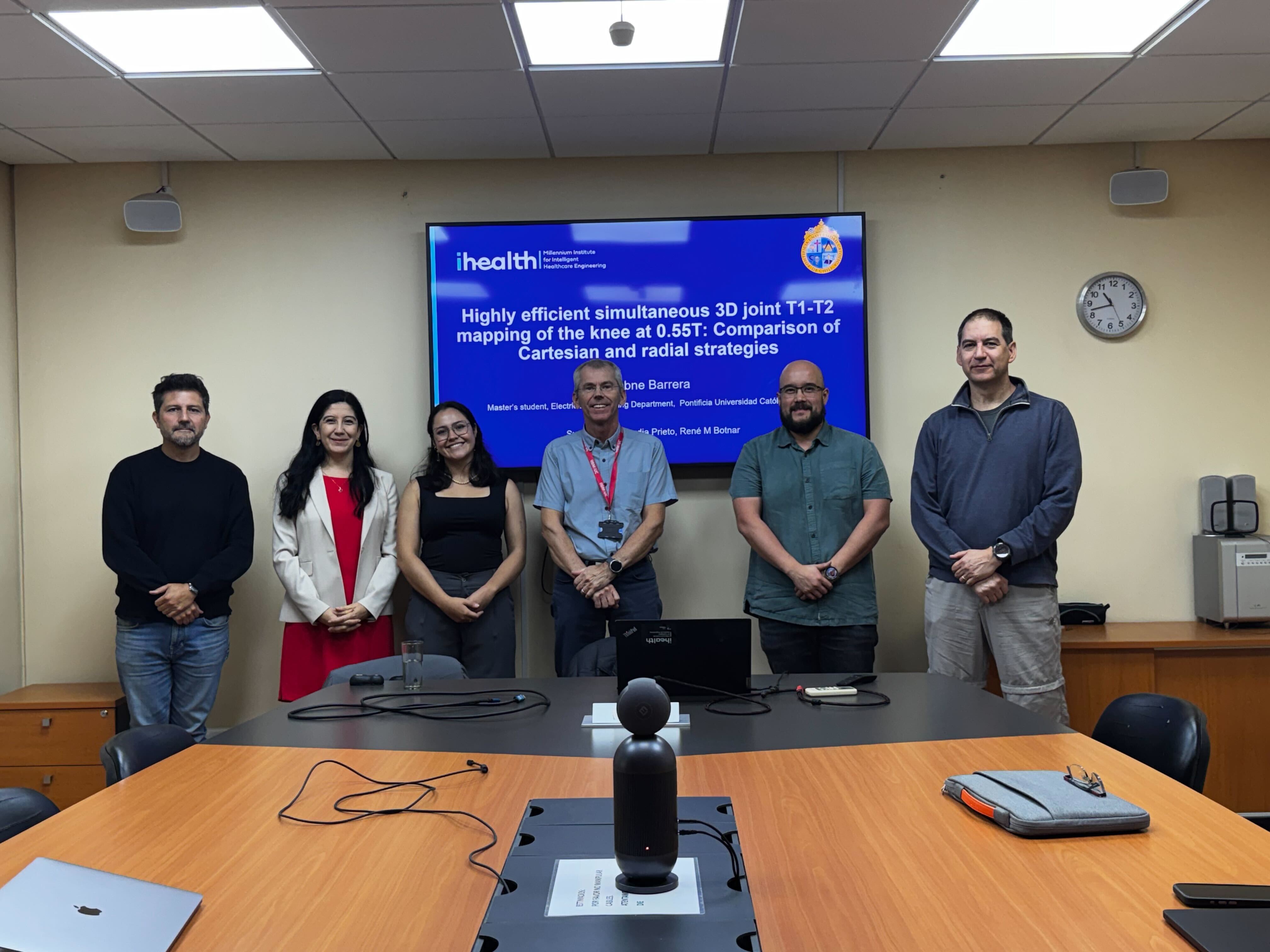
Dabne Barrera, a Master's student in Engineering Sciences at the Pontificia Universidad Católica de Chile, successfully defended her thesis on Monday, March 30, 2026, at the San Joaquín campus. Her research managed to reduce low-field magnetic resonance imaging acquisition time from 11 minutes to just 3 and a half minutes.
Low-field magnetic resonance imaging (LFMRI) represents a more affordable and accessible alternative to traditional equipment, and is also more suitable for people with claustrophobia or noise sensitivity. However, one of its main challenges is the duration of the exams. Dabne Barrera's work addresses precisely that problem.
"By working with mathematical tools and exploiting the physics of the scanner, we can reduce the time, and therefore the cost of this type of exam — whereas before 12 patients could be seen per day, now it could be 23 with the same equipment," the researcher explained.
Titled Low-field quantitative magnetic resonance imaging for simultaneous 3D T1 and T2 mapping of the knee, the thesis compares two image acquisition trajectories — one Cartesian and one radial — to determine which allows for faster and more accurate characterization of the hyaline cartilage of the knee using low-field MRI.
The work was carried out by Dabne at the Millennium Institute IHealth, "thanks to its spectacular facilities for developing studies like mine," as she noted. "Having a scanner available and being able to use it at any time of day, testing ideas on a piece of equipment that is three steps from your office, is one of the great advantages of having done my work here," the researcher emphasized.
In addition to access to equipment, she highlighted the value of the interdisciplinary environment: "At IHealth there are mechanical, electrical, and biomedical engineers, all working on something similar but with different backgrounds. That interaction was very enriching."
Women in Research
Dabne Barrera arrived in Chile in 2022 from Colombia for a research internship with Dr. Claudia Prieto, principal investigator at IHealth.
"In an image processing course, I was asked to read a paper by Professor Claudia that I found very interesting. I started following her work, and one day an exchange opportunity came up, so I came to Chile. I spent five months working with her," Dabne recalls.
"Working with the professor felt very natural, organic, and enriching, so I asked to come back for my Master's. I always wanted to pursue academia, but working alongside Professor Claudia motivated me even more. She is one of my female role models, and having worked with her was very rewarding — something that motivates me greatly to continue here in Chile," describes the current doctoral student.
After completing her Master's, Dabne Barrera has already begun her PhD at UC's Institute for Biological and Medical Engineering, also in collaboration with IHealth. Her new project aims to develop cardiac imaging sequences that are robust to cardiac motion and do not require patients to hold their breath — a more technically complex challenge than the knee work. "Four years of research are ahead, and I'm very excited," she concludes.
