PhD students win second place in international medical imaging competition at MICCAI 2026
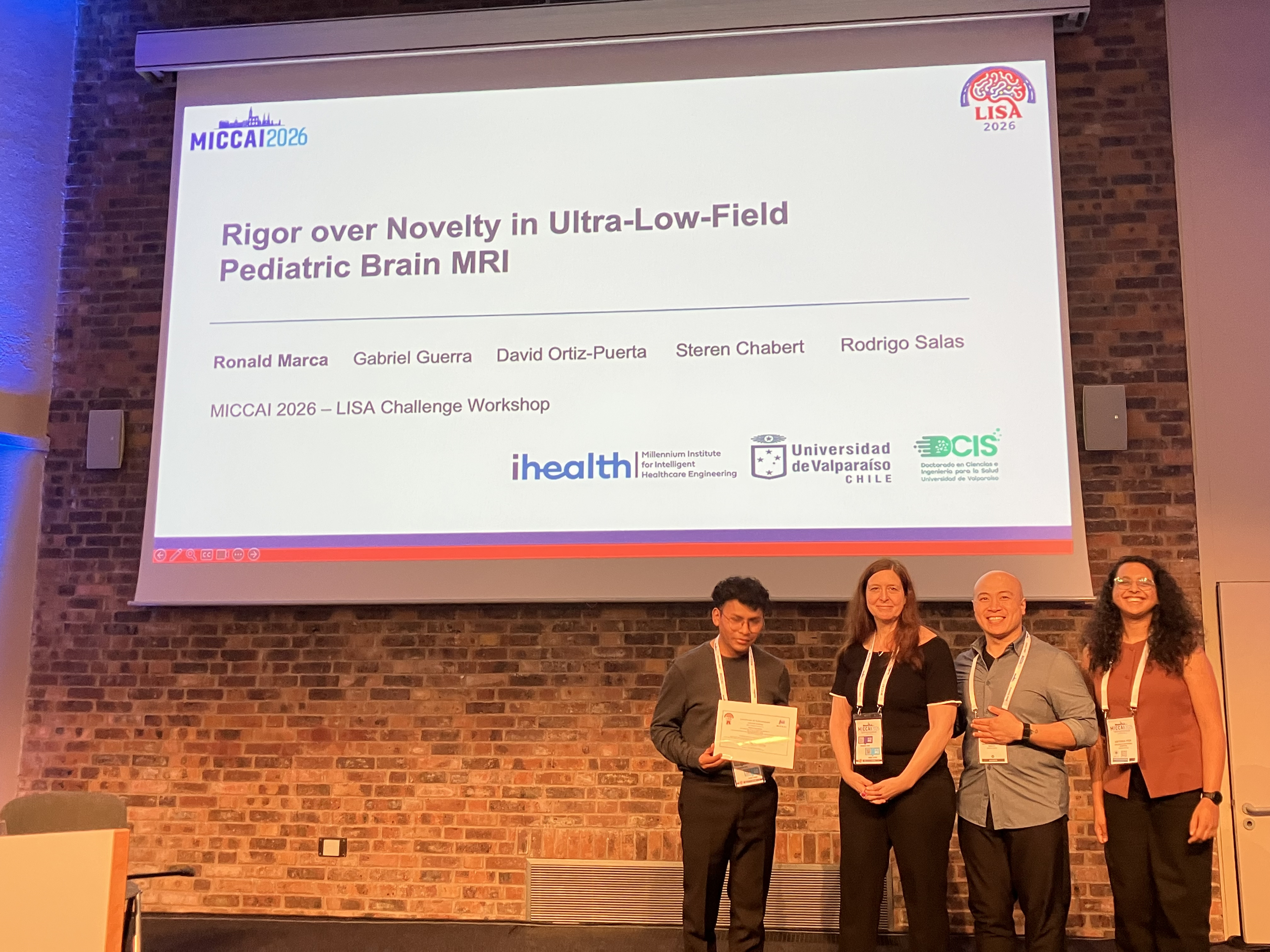
Ronald Marca and Gabriel Guerra, students at Universidad de Valparaíso and members of iHEALTH, were recognized at the LISA Challenge 2026 for their work on pediatric brain MRI scans acquired with portable ultra-low-field scanners. Marca presented the results in an oral session in Strasbourg, France.
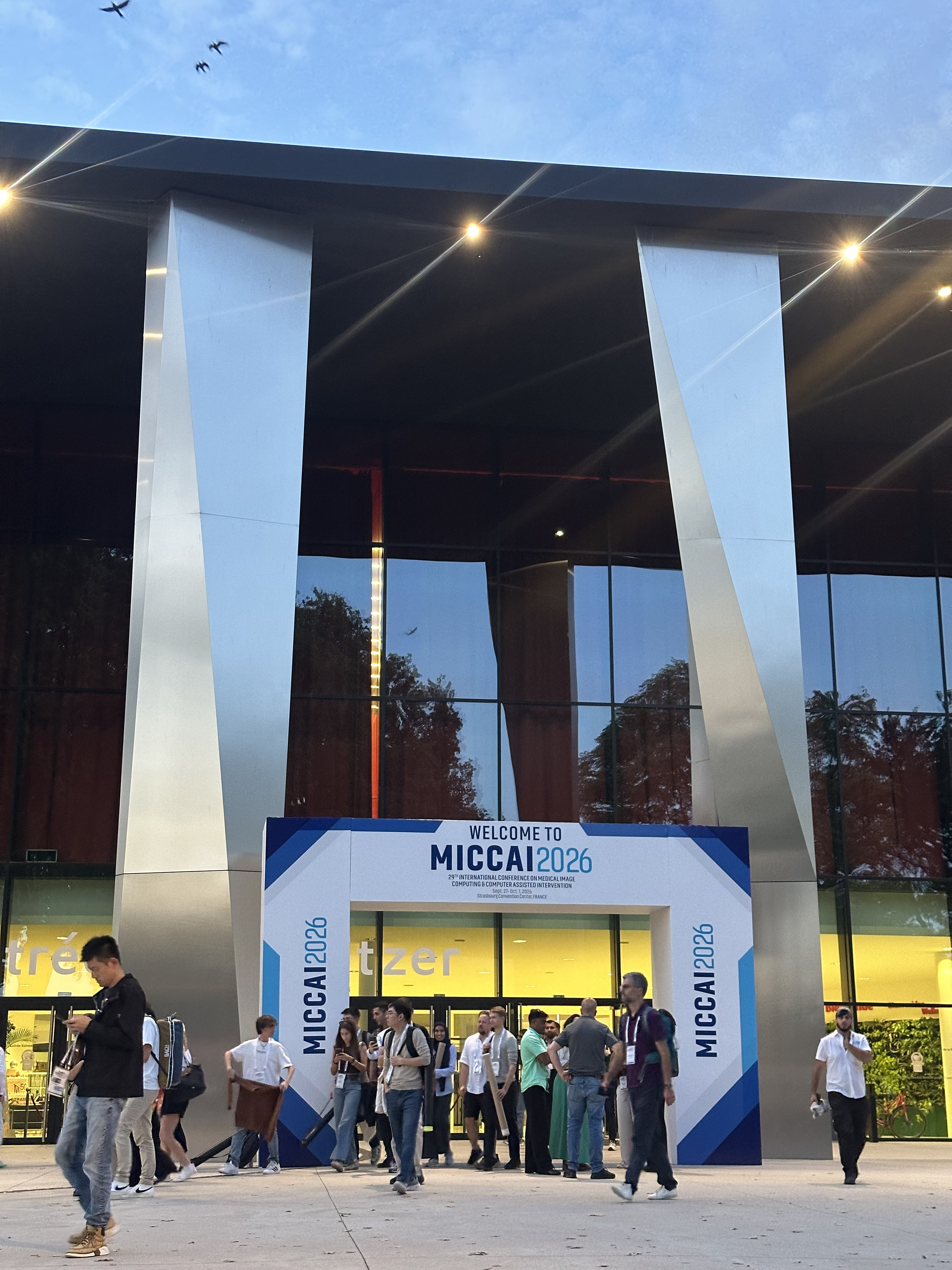
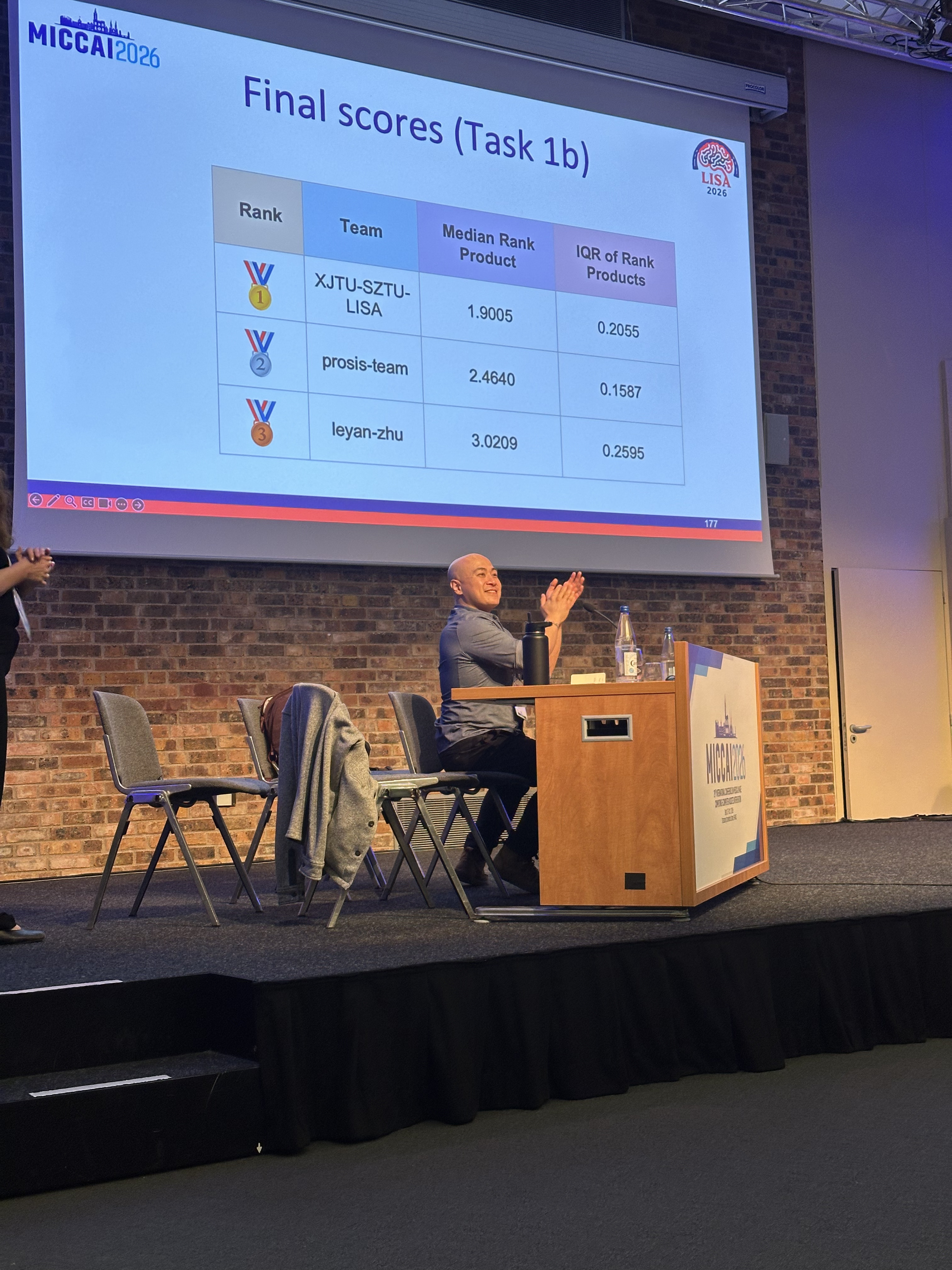
A team from the Millennium Institute iHEALTH, Universidad de Valparaíso and the MEDING Center won second place in the image quality enhancement task of the LISA Challenge 2026. This international scientific competition was held as part of the 29th International Conference on Medical Image Computing and Computer Assisted Intervention (MICCAI 2026), the world's leading conference on medical image analysis and artificial intelligence applied to healthcare.
The paper, titled "Rigor over Novelty in Ultra-Low-Field Pediatric Brain MRI: Quality Control and Subcortical Segmentation for the LISA Challenge 2026", was also selected for oral presentation. Ronald Marca presented it on October 1 in Strasbourg, France, where the conference took place.
Marca and Gabriel Guerra are completing the Master's in Biomedical Engineering at UV and this year entered the PhD program in Health Sciences and Engineering at the same university. The project was supported by Rodrigo Salas, Steren Chabert and David Ortiz, faculty members of the UV School of Biomedical Engineering and iHEALTH researchers.
Portable MRI where there is no conventional scanner
The LISA Challenge works with brain MRI scans of children acquired with a portable ultra-low-field scanner (0.064 Tesla). These scanners do not require a shielded room and run on a standard power outlet. As a result, they can reach places that conventional scanners (1.5–3 Tesla) cannot.
The difficulty is that their signal is about 100 times weaker than that of a hospital scanner. The resulting images have more noise, less contrast and less detail, which makes automated analysis harder.
In MICCAI challenges, teams from different countries tackle a common clinical problem using the same data. The organizers evaluate the results with information the teams do not have access to and rank them in an official leaderboard. The Chilean team took part in all three tasks of the competition: image quality control, image enhancement and segmentation of brain structures.
In the image enhancement task, the team trained four artificial intelligence models and added a fifth control candidate: the original image, only carefully cleaned and normalized, with no learned model at all. In the official ranking, that control outperformed all four trained models and was the only one that made the image look more natural according to the quality metrics.
"The original image, with careful cleaning and nothing else, outperformed everything we trained, and that is a finding worth reporting in its own right," explains Ronald Marca. "We came close to fooling ourselves with our own evaluation: the model that looked best in our internal tests performed worst in the real evaluation."
The paper identifies the reasons. The reference images do not match the low-field images exactly, so a model that learns from them ends up "inventing" details in the wrong places. In addition, a significant part of the problem lay in the preprocessing: simply correcting how the image was resized and saved turned the result from making the image worse to making it better.
In the other two tasks, an ensemble of neural networks automatically graded seven types of artifacts with 84% accuracy. A standard 3D segmentation model achieved an average 78% overlap with expert delineations across eleven brain structures.
"Across all three tasks, careful and honest evaluation mattered more than architectural novelty," says Marca. As a next step, the team will work on improving the alignment between the low-field images and the reference images.
The result helps make portable, low-cost MRI reliable for the pediatric population in places with limited access to medical imaging. It also provides a baseline for measuring future progress in the field.