iHEALTH researchers recognized in Stanford and Elsevier’s global Top 2% Scientists ranking
The ranking, based on Scopus data, identifies the most cited scientists in the world in their respective fields.
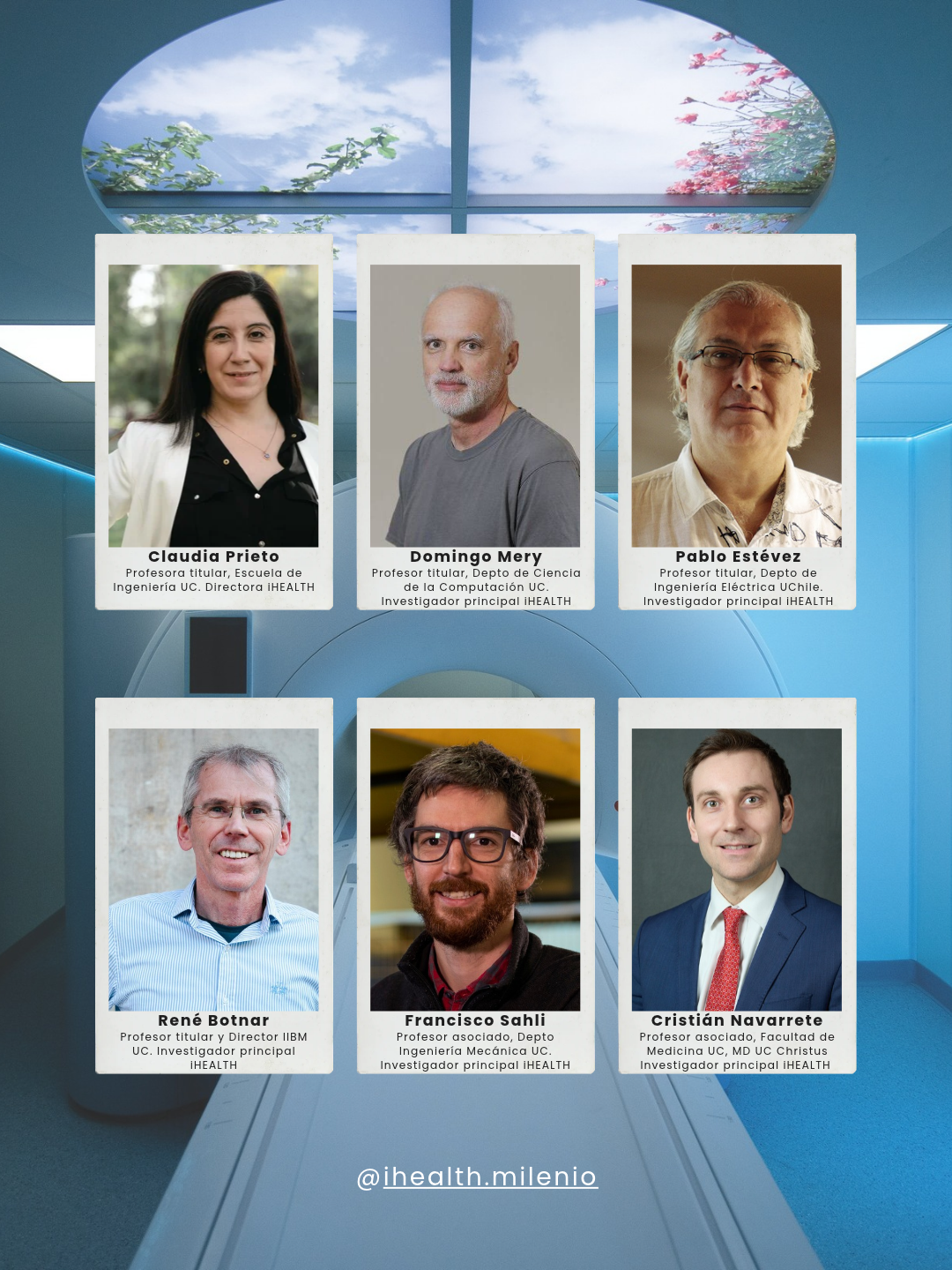
Six principal investigators from the Millennium Institute for Intelligent Healthcare Engineering, iHEALTH, are featured in the 2026 edition of the Top 2% Scientists ranking, compiled by Stanford University and Elsevier. Among them is the institute’s director, Dr. Claudia Prieto, along with Dr. Domingo Mery, Dr. Pablo Estévez, Dr. René Botnar, Dr. Francisco Sahli and Dr. Cristián Navarrete.
Based on the Scopus database, the ranking recognizes researchers whose work has had the greatest influence in their respective fields. It evaluates both each scientist’s entire career and their performance in a single recent year.
Scientists are selected from more than 100,000 Scopus profiles using the c-score, a composite indicator that considers not only the number of citations but also factors such as authorship position and co-authorship.
Impact on artificial intelligence, biomedical engineering and medical imaging
The recognition highlights research that has helped advance fields such as artificial intelligence applied to healthcare, biomedical engineering and medical imaging, with publications widely cited by the international scientific community.
iHEALTH Director Dr. Claudia Prieto said: “On a personal level, being part of this ranking is a testament to the collaborative and interdisciplinary work we carry out in medical imaging and AI at iHEALTH and UC. It also reflects the valuable contribution of undergraduate and graduate students, as well as the national and international collaborations that strengthen our scientific work.”
Dr. Domingo Mery emphasized the collective nature of the distinction: “It’s a recognition that makes me very happy, because it is certainly not just for me, but for everyone I have had the opportunity to work with, many of them graduate students,” he said.
Dr. Cristián Navarrete, meanwhile, said he was “grateful and honored, because this reflects the work of many people: students, residents and faculty at the University, as well as collaborators from around the world.” He added: “I am very glad that we can contribute from Chile to the world. We hope to keep working together and that this will translate into better care for our patients.”
Dr. Pablo Estévez noted: “On a personal level, being recognized in 2025 and also across my entire career is an excellent acknowledgment.” Dr. Francisco Sahli added that the recognition “shows that we can do world-class science from Chile.”
Finally, Dr. René Botnar focused on the impact of research beyond metrics: “It’s nice to be in the top 2%, but what matters most to me is that people actually start using what we develop.” He explained that his work with Siemens turns research developments into new products, and that collaborating with physicians at different hospitals broadens the reach of his research. “Citations are very important to me, but what matters most is that patients and doctors can benefit from our developments,” he said.
With this achievement, iHEALTH researchers reaffirm their commitment to scientific excellence, contributing new knowledge and solutions that improve the health and well-being of people in Chile and around the world.
