Artificial Intelligence Labels Brain Arteries with Expert-Level Precision
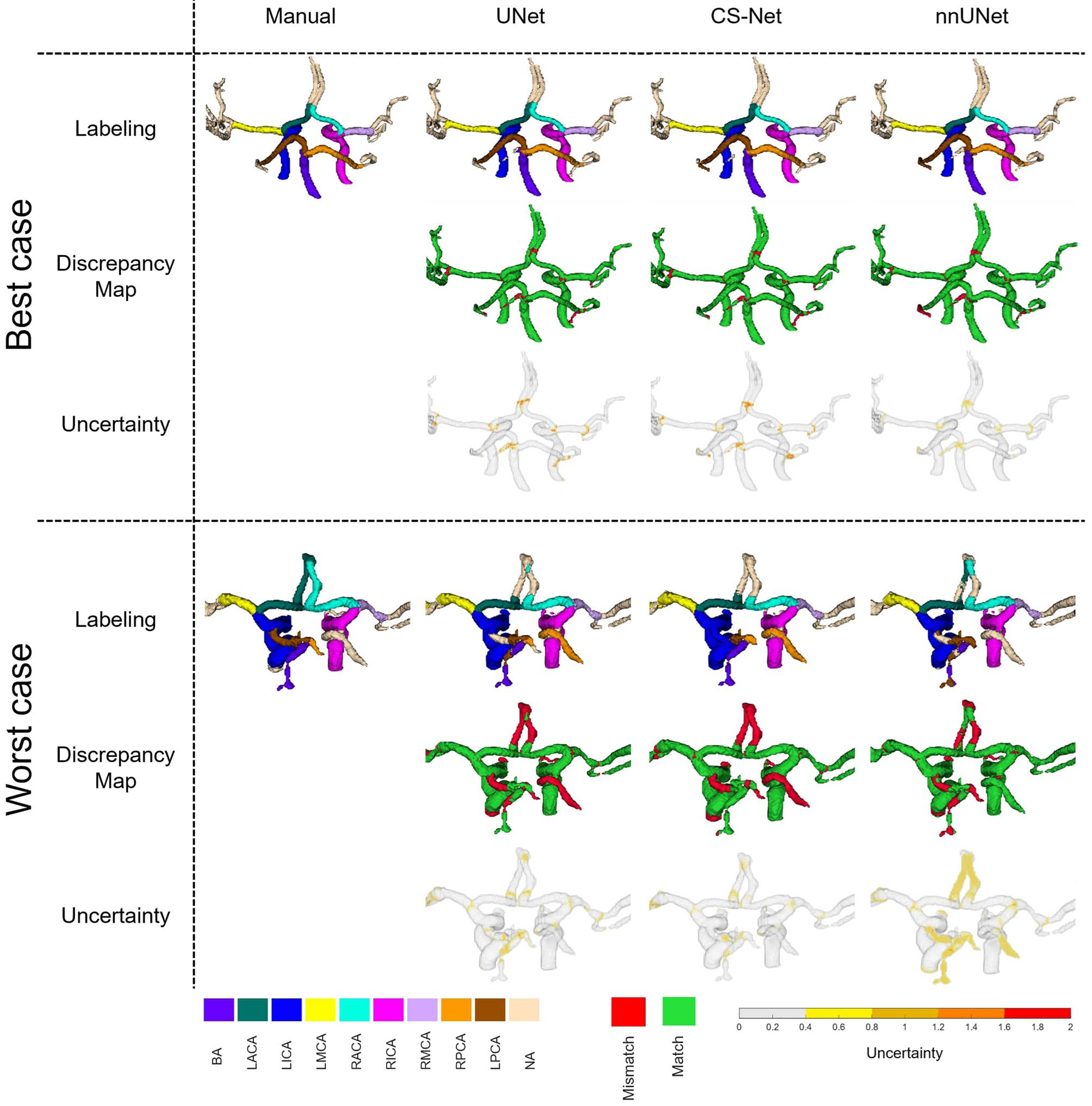
A study shows no significant differences between automated and manual labeling of intracranial arteries — both methods yield equivalent results. Furthermore, the automated approach can provide uncertainty measures to generate alerts when the network is processing data with anatomical ambiguities.
Anatomical labeling of intracranial arteries is fundamental to cerebrovascular diagnosis and hemodynamic analysis. It is a time-consuming process prone to inter-operator variability, as noted in a study recently published in BMC Medical Imaging.
Processing time can range from 30 minutes to one hour per patient, depending on the complexity of the vascular network. "Since every person is different, defining where each segment begins and ends can be difficult to apply across all cases," says Javier Bisbal, an IHEALTH doctoral student and lead author of the paper.
While automated solutions exist, their clinical adoption is limited by the lack of confidence measures. "Current methods only deliver label results, without additional metrics to help understand how the process works — creating a kind of black box," as Bisbal explains.
That is why the study implements uncertainty measures which, as the researcher notes, "help overcome this barrier, with visual tools to identify zones where the network may produce ambiguous results requiring expert review — for example, stenotic vessels and uncommon anatomical variations." These are calculated through multiple predictions from the network on variations of the same input segmentation.
Putting the Networks to the Test
The team evaluated three distinct neural network architectures: UNet, CS-Net, and nnUNet. The first serves as the baseline for comparison, "previously implemented for intracranial labeling, but without uncertainty," as the Millennium Institute researcher adds. CS-Net, meanwhile, is a UNet variant with attention modules designed to improve the segmentation of curvilinear structures such as vessels, adapted in this paper for the labeling task.
Finally, nnUNet is a widely popular algorithm that enables automated design of UNet networks for segmentation based on training data characteristics. It has proven highly successful across multiple segmentation and labeling tasks for organs and tissues throughout the body.
Based on the results, both nnUNet and CS-Net achieve better performance than the baseline UNet. "As future work, I propose combining the strengths of both: nnUNet's automatic configuration and CS-Net's attention modules," says Bisbal, who conducted this research during a residency at the Karolinska Institutet in Sweden, in collaboration with the University of Greifswald, Germany.
This work is part of a larger project aimed at developing a comprehensive system to analyze blood flow in the cerebral vasculature — encompassing vessel segmentation, automated artery labeling, and super-resolution enhancement of MRI images — with the goal of extracting standardized hemodynamic indicators of patients' vascular health.
"This would be one of the last missing pieces of the pipeline, and the next step is to integrate and validate them together in larger cohorts of patients and volunteers. In short, it is applicable, but further validation on more data is still needed," the researcher concludes.
Bisbal, J., Winter, P., Jofre, S. et al. Uncertainty-aware automated labeling of intracranial arteries using deep learning. BMC Med Imaging 26, 175 (2026). https://doi.org/10.1186/s12880-026-02276-5