Seminar November 21TH, 2023

Hours: 16:30 - 18:00
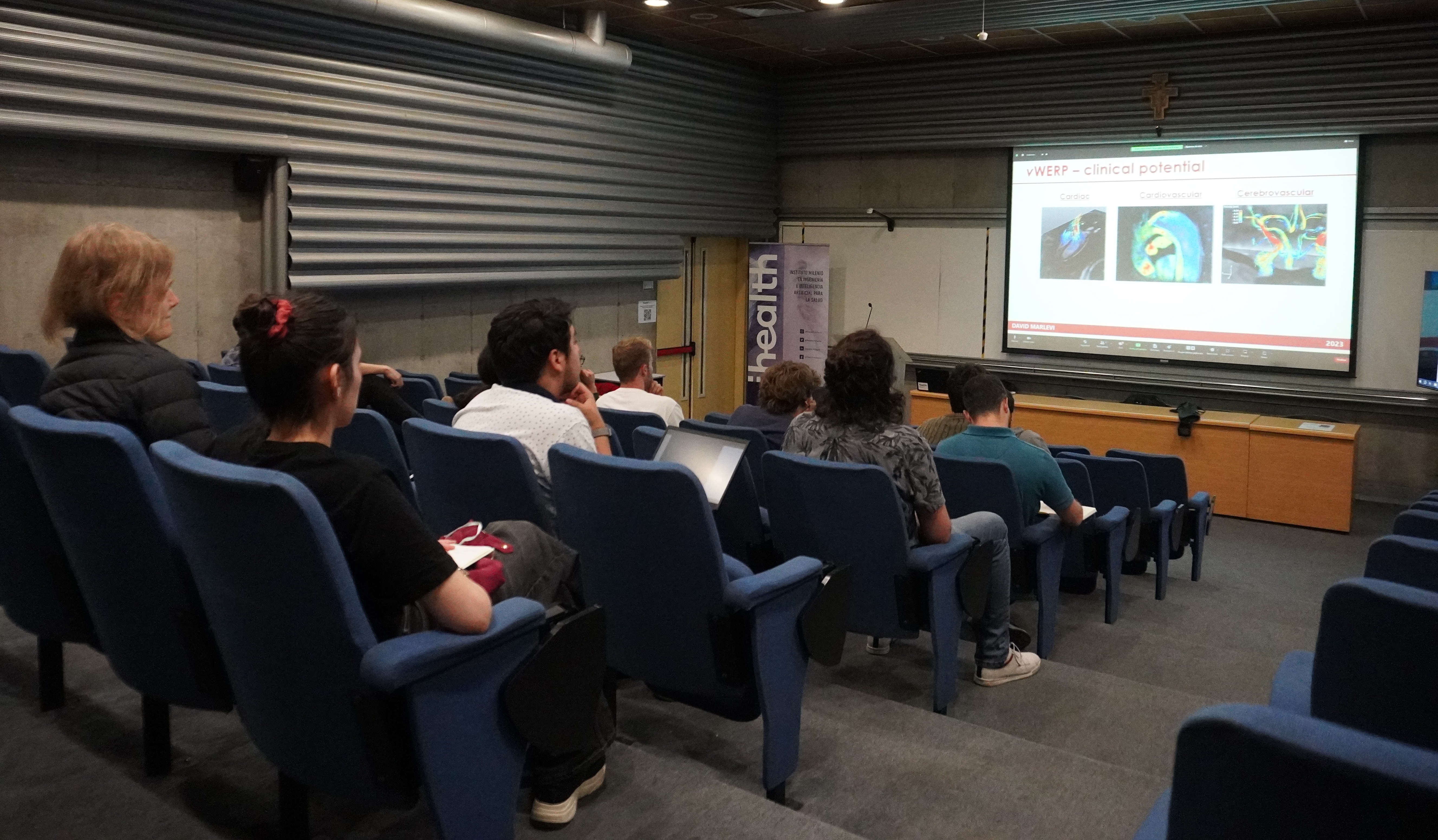
DAVID MARLEVI, PhD.
Title: 4D Flow MRI and non-invasive estimation of pressure gradients
Abstract: Regional quantification of cardiovascular pressure gradients is critical for diagnosis, treatment planning, and risk prediction of many cardiovascular diseases. Still, for a large number of conditions, non-invasive assessment is obstructed by inherent method limitations, leaving a wide range of cardiovascular instances where regional pressure behaviour remains unexplored. Through the incorporation of full-field phase-contrast magnetic resonance imaging (4D Flow MRI) and physics-driven image analysis, however, previously inaccessible compartments are now opening up for hemodynamic quantification, not least including derivation of regional pressure changes. This talk will present recent developments in this space, utilizing data-driven methods to probe for pressure changes across the cardiovasculature, and utilizing super-resolution techniques to quantify behaviour in clinically challenged compartments.
Bio: David Marlevi is a researcher and principal investigator at Karolinska Institutet (KI), in Stockholm, Sweden. After graduating from the joint PhD program in Medical Techology at Royal Institute of Technology (KTH) and KI with a thesis entitled “Non-invasive imaging for improved cardiovascular care”, Dr. Marlevi spent two years as a postdoctoral fellow at the Massachusetts Institute of Technology (MIT), leading work on quantitative imaging and intravascular interventional assessments under the tutelage of Prof. Elazer Edelman. In 2021, Dr. Marlevi returned to Sweden and KI, leading work on translational cardiovascular imaging and utilizing data-driven methods to enhance diagnosis, improve prognosis, and provide fundamental mechanistic understanding of cardiovascular disease. In 2023, Dr. Marlevi was also the recipient of a European Research Council (ERC) Starting Grant, with large-scale efforts now commencing on the development of full-field phase-contrast magnetic resonance imaging (4D Flow MRI) for functional hemodynamic mapping across the heart, aorta, and brain.
RODRIGO AVARIA, PhD(c)
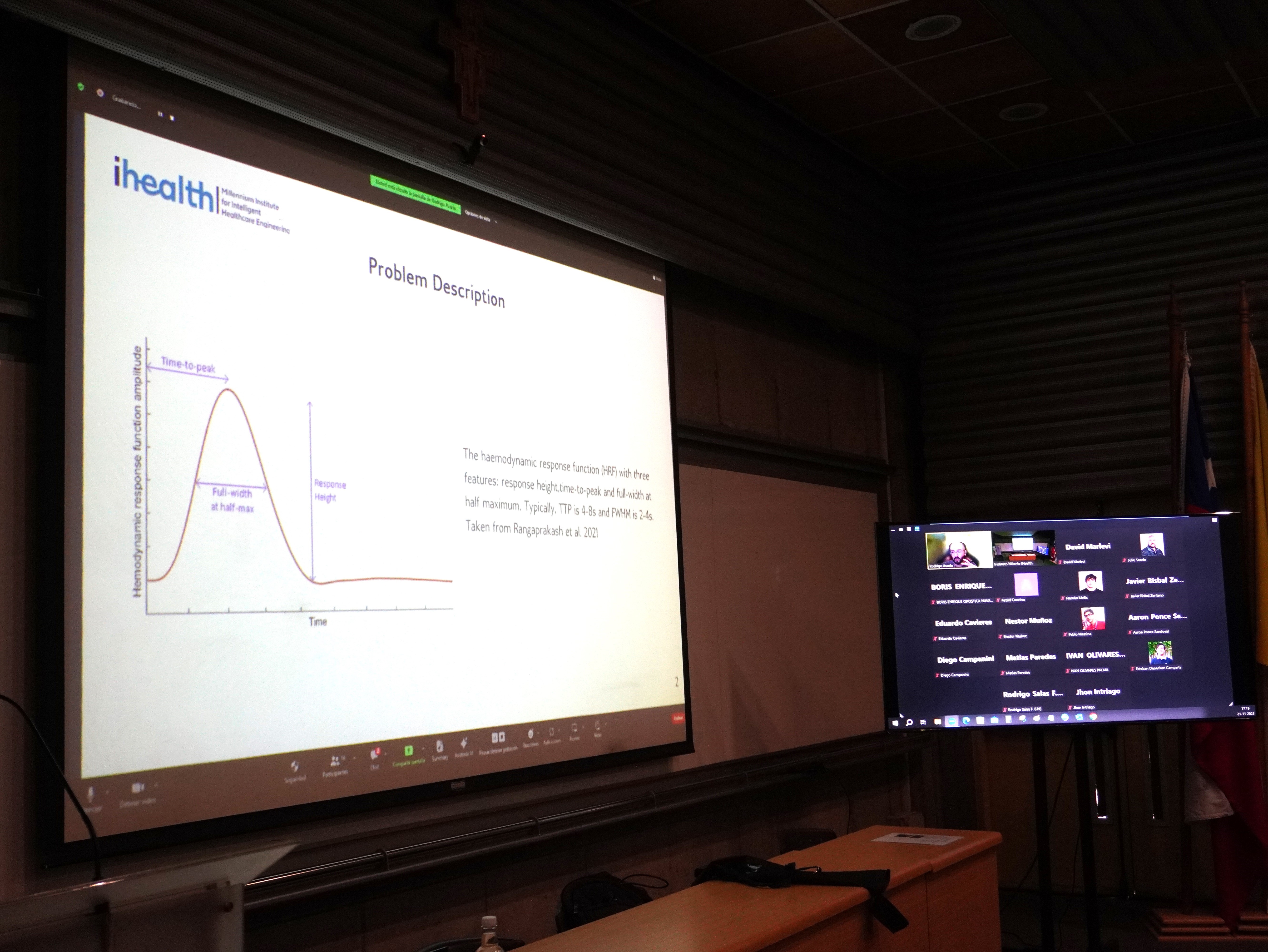
Title: A Robust PINN for Modelling the Haemodynamic Response Function in fMRI
Abstract: Functional Magnetic Resonance Imaging (fMRI) has demonstrated its potential for exploring the brain and cognition. The basis of the variation in the BOLD signal is modelled through a haemodynamic response function (HRF), which is considered a marker of neurovascular coupling integrity involving multiple actors such as neurons, glial cells, and epithelial cells through complex mechanisms. There is clinical interest in assessing the HRF under various conditions as it has been observed to vary and be sensitive to various physiological conditions, such as aging and diabetes, among others. Despite advances in the field, robust estimation of the HRF remains a challenge; hence, there is a need to develop a robust methodology for estimating the HRF.
On the other hand, in recent years, there have been methodological advances that leverage prior knowledge of certain physical laws to "guide" machine learning, known as Physics-Informed Neural Networks (PINN). PINNs are characterized by their ability to integrate experimental data and abstract mathematical operators, including differential equations, even in uncertain, high-dimensional, partially understood contexts, or where physical knowledge is lacking, and the data is noisy or sparse.
Our proposal is to use PINNs for robust estimation of the HRF, a framework that, based on the Balloon model proposed to explain cerebral haemodynamic responses, demonstrates its robustness under low signal-to-noise ratio, low magnetic fields, or limited data availability. The Balloon model expresses the BOLD signal as a function of two state variables: local blood volume and deoxyhemoglobin content, proposing a set of equations to describe their rates of change in relation to local blood flow, mean transit time, oxygen extraction fraction, and vessel stiffness.
Bio: Rodrigo has a BSc in pure Maths from the Universidad de Chile. He has worked on Cognitive and Computational Neurosciences. He is currently a PhD candidate for the statistics doctoral programme at the University of Valparaiso under Professor Rodrigo Salas's supervision and Professor Steren Chabert's co-supervision.