Seminar November 07TH, 2023
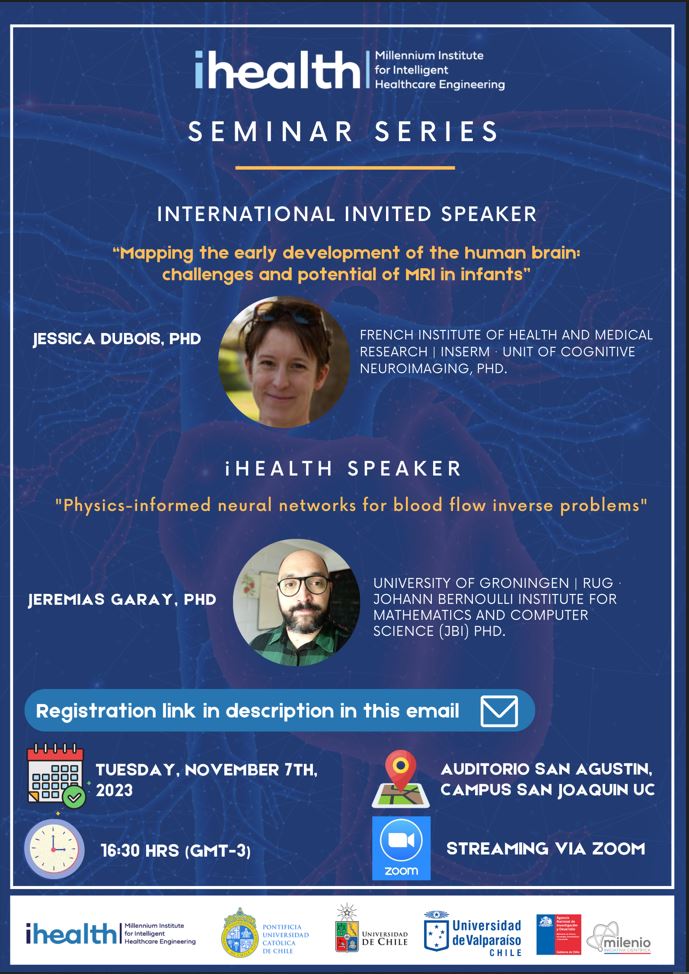
Hours: 16:30 - 18:00
JESSICA DUBOIS
Title: Mapping the early development of the human brain: challenges and potential of MRI in infants
Abstract: Studying how the infant brain develops and becomes functional is essential to better understand the early influence of fetal or perinatal events on later life, as well as the intense interactions between genetic, epigenetic and environmental factors. Non-invasive neuroimaging approaches are then needed to link structural and functional brain development in vivo. In recent years, major advances have been made in magnetic resonance imaging (MRI) techniques that can be combined with electrophysiological approaches and behavioral follow-up to assess children’s sensorimotor acquisitions and cognitive learnings. Nevertheless, imaging the infant brain involves several limitations in data acquisition and post-processing, due to issues related to motion artefacts, brain size and image contrast which are strongly different in the immature brain compared to the adult brain. The analysis of MRI data (e.g. anatomical, diffusion or relaxometry images) of infants therefore requires the development of dedicated methodologies to provide accurate and relevant information about developing brain networks. In this talk, we will focus on some processes that take place during the pre-term and early post-term periods: brain folding, maturation of cortical microstructure and of white matter tracts. We will discuss the main challenges of related analyses, as well as the potential of multiparametric MRI and artificial intelligence approaches to predict outcome in infants at risk of neurodevelopmental disorders.
Bio: Jessica Dubois is a neuroscience researcher at Inserm (NeuroDiderot Unit, France), at the NeuroSpin center (CEA, Saclay) and the Robert-Debré Children’s Hospital (Paris). She co-leads the inDEV team on the “Imaging of neurodevelopmental phenotypes”. She obtained an engineering degree in 2001 (Ecole Centrale Paris) and a PhD in Physics in 2006 (University Paris 11). Her research focuses on early human brain development studied in preterm newborns and typical infants with non-invasive neuroimaging techniques: magnetic resonance imaging (MRI) and high-density electroencephalography (EEG). She has detailed the organization and maturation of the infant brain at the structural level, as well as the links to the properties of functional responses in MRI-EEG studies of the visual and auditory modalities. Combining multimodal neuroimaging, behavioral assessments and machine learning, her current projects focus on sensory-motor development, in typical infants and infants at risk of developing cerebral palsy. She has published over 60 peer-reviewed articles: https://jessica-dubois.weebly.com/publications.html
JEREMIAS GARAY LABRA
Title: Physics-informed neural networks for blood flow inverse problems
Abstract: Physics-informed neural networks (PINNs) have emerged as a powerful tool for solving inverse problems, especially in cases where no complete information about the system is known and scatter measurements are available. This is especially useful in hemodynamics since the boundary information is often difficult to model, and high-quality blood flow measurements are generally hard to obtain. In this work, we use the PINNs methodology for estimating reduced-order model parameters and the full velocity field from scatter 2D noisy measurements in the ascending aorta. The results show robust and accurate parameter estimations when using the method with simulated data. In contrast, the velocity reconstruction accuracy shows dependence on the measurement quality and the flow pattern complexity. The method allows for solving clinical-relevant inverse problems in hemodynamics and complex coupled physical systems.
Bio: Jeremias Garay is a postdoctoral fellow at the Pontifical Catholic University of Chile working on how deep learning techniques can be applied to clinical-relevant inverse problems in the area of hemodynamics. He holds a Ph.D. in Computational
Mathematics from the University of Groningen, The Netherlands. His research interests include computational hemodynamics, fluid-solid interaction, and blood flow turbulence, and how these areas could assimilate clinical imaging techniques such as MRI, Doppler, and CT for defining and solving relevant inverse problems.
