Seminario 23 de Mayo 2023
Horario: 16:30 - 18:00
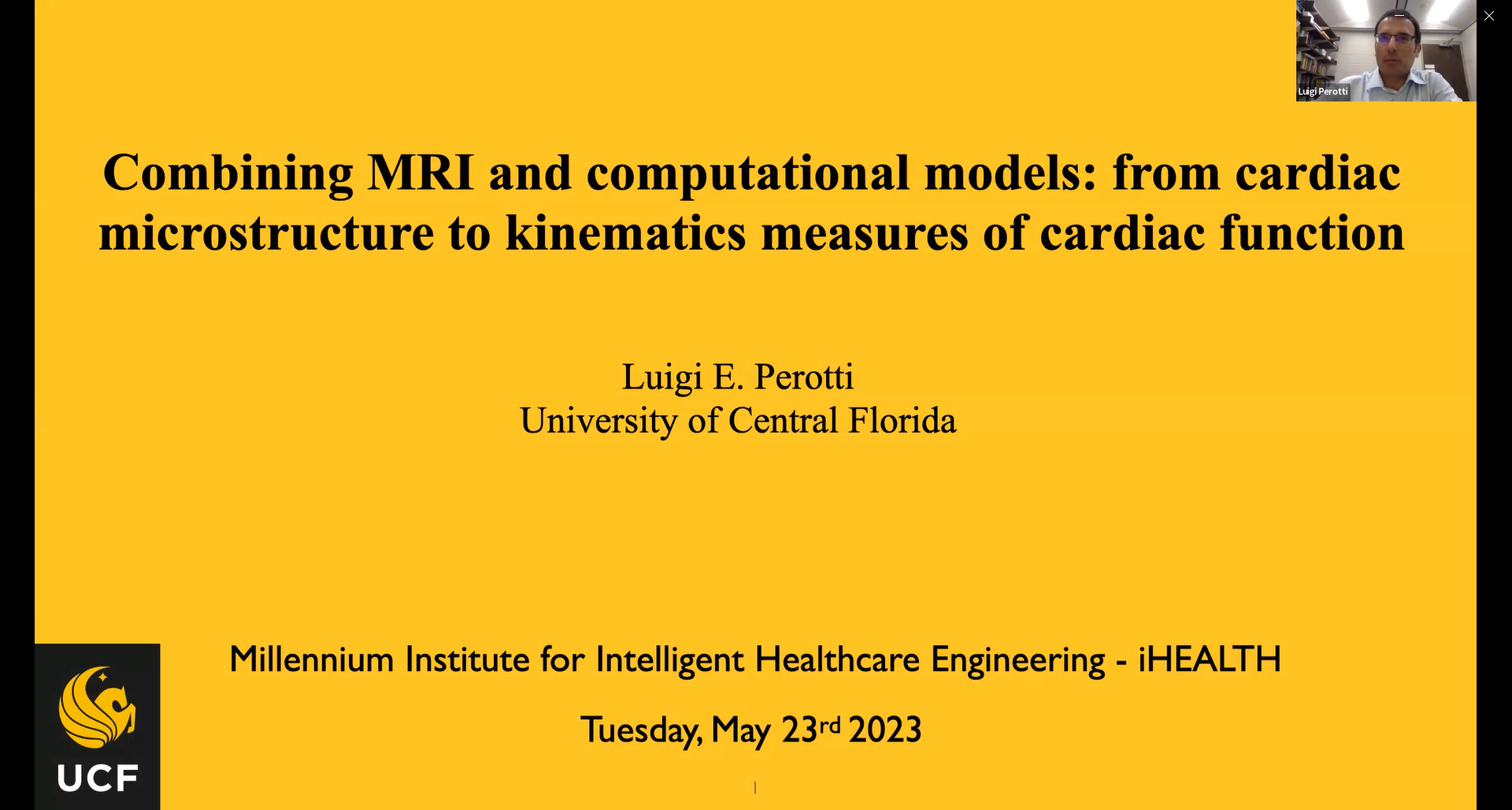
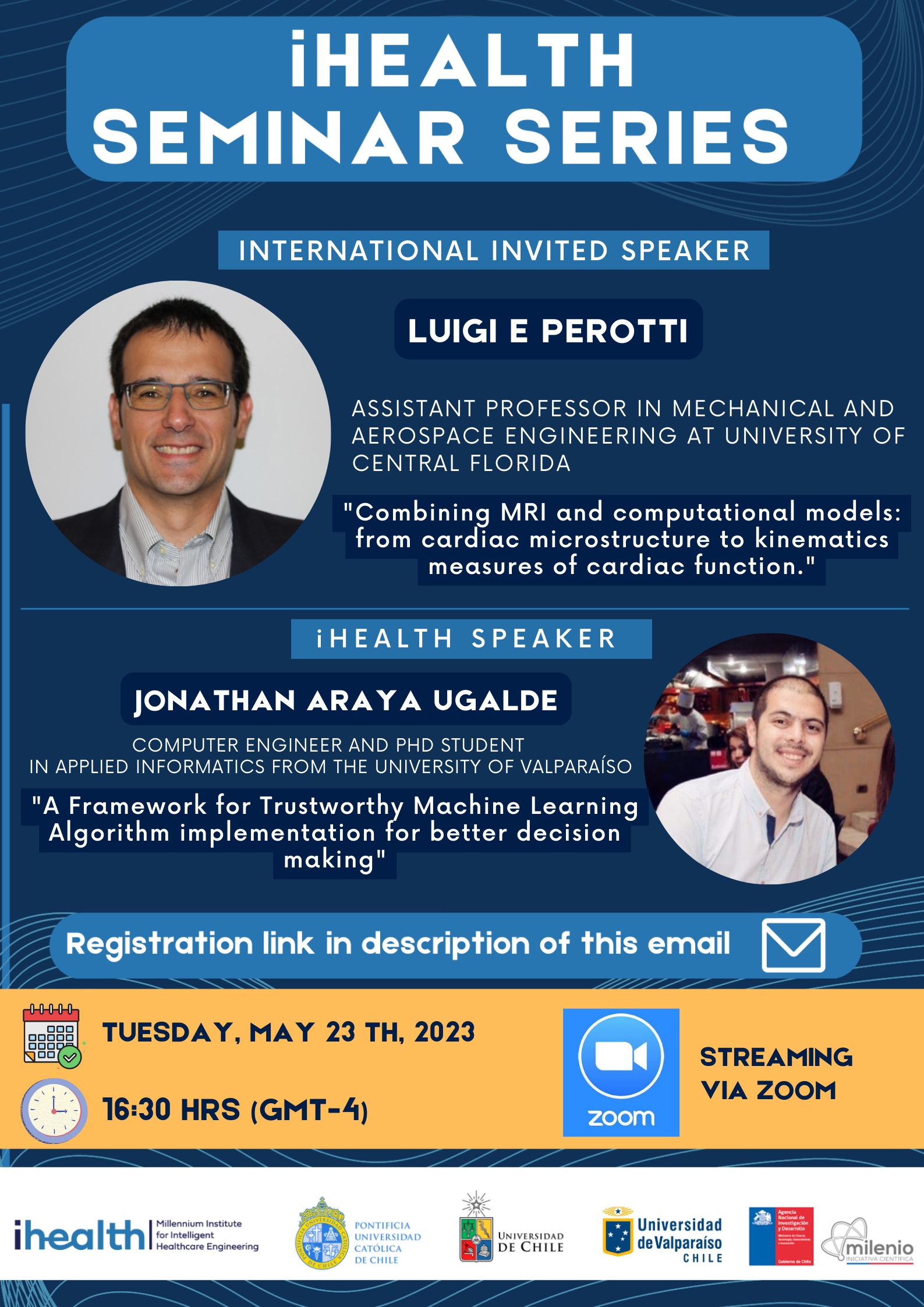
Luigi E. Perotti
Título: Combinación de MRI y modelos computacionales: de la microestructura cardíaca a las medidas cinemáticas de la función cardíaca.
Resumen: Los modelos computacionales pueden ayudar a analizar imágenes médicas del corazón para extraer biomarcadores útiles de la salud cardíaca. En este trabajo, presentamos biomarcadores relacionados con la microestructura y el movimiento del corazón, y cómo estos biomarcadores se pueden calcular a partir de imágenes de tensor de difusión cardíaca (cDTI) y datos de resonancia magnética de codificación de desplazamiento con ecos estimulados (DENSE).
Primero, investigamos cómo se pueden emplear medidas de tensor de difusión basadas en cDTI para identificar cambios en la microestructura del corazón. En este contexto, proponemos la difusividad radial como biomarcador de la remodelación microestructural cardíaca e interpretamos sus cambios mediante simulaciones de difusión de partículas. Posteriormente, calculamos la difusividad radial, las invariantes del tensor de difusión estándar (como la difusividad media y la anisotropía fraccional) y las medidas basadas en el contraste en sujetos porcinos con infarto de miocardio utilizando datos de IRM tanto in vivo como ex vivo. Entre todos los biomarcadores no basados en contraste, la difusividad radial aumenta significativamente desde el miocardio remoto hasta el infartado, mientras que es más sólida que los cambios en los valores propios del tensor de difusión separados.
Posteriormente, combinamos datos de microestructura cardíaca (cDTI) y movimiento (DENSE) para evaluar el Eff de tensión de miofibras, una medida de deformación cardíaca que está anclada microestructuralmente, es decir, independiente de sistemas de referencia arbitrarios, y directamente relacionada con la contracción y relajación de los cardiomiocitos. Primero estimamos Eff interpolando y diferenciando directamente los desplazamientos miocárdicos de vóxeles de Lagrangian para calcular el tensor de deformación de Green-Lagrangian y luego proyectarlo en la dirección de las miofibras calculada a partir de cDTI. Posteriormente, derivamos un nuevo método para evaluar Eff minimizando las diferencias entre los desplazamientos medidos a través de DENSE y calculados a través de un modelo computacional de cinemática. Este segundo enfoque evita la necesidad de diferenciar directamente el campo de desplazamiento medido y, por lo tanto, limita el impacto del ruido experimental.
La difusividad radial y el Eff representan dos ejemplos de biomarcadores que podrían mejorar nuestra evaluación de la función cardíaca. En última instancia, los modelos computacionales informados por resonancia magnética tienen el potencial de proporcionar nuevos índices de la función cardíaca y ayudar a mejorar el diagnóstico y el pronóstico de los pacientes afectados por enfermedades cardíacas.
Biografía: Luigi Perotti recibió su título Laurea (B.S./MS) en Ingeniería Civil del Politecnico di Milano, Italia, en 2004. Posteriormente, continuó sus estudios en Ingeniería Mecánica en Caltech, donde recibió su M.S. en 2006 y su Ph.D. con una especialización en Matemáticas Aplicadas y Computacionales en 2011. A finales de 2011, se unió al grupo del Dr. Klug en el departamento de Ingeniería Mecánica y Aeroespacial de la UCLA para dedicarse a sus intereses de investigación en biomecánica. Desde entonces, ha trabajado en varios proyectos multidisciplinarios que involucran colaboraciones entre los Departamentos de Física, Radiología y la Facultad de Medicina. En 2014 recibió una beca posdoctoral de la AHA y se unió al grupo del Dr. Ennis en el departamento de Ciencias Radiológicas de la UCLA. En 2017 recibió un premio NIH K25 para continuar su investigación sobre la combinación de modelos computacionales con datos de MRI y realizar estudios preclínicos. El Dr. Perotti se unió al departamento de Ingeniería Mecánica y Aeroespacial de la Universidad de Florida Central en 2019, donde dirige el Laboratorio de Biomecánica Computacional.
Jonathan Araya Ugalde
Título: Un marco para la implementación de algoritmos de aprendizaje automático confiables para una mejor toma de decisiones.
Resumen: La expansión del Machine Learning en muchos aspectos de nuestra vida diaria es innegable. La gran versatilidad y capacidad predictiva de los algoritmos de Machine Learning ha propiciado su uso en publicidad web, reconocimiento facial, diagnósticos médicos, entre otros campos. Sin embargo, el énfasis en mejorar solo el rendimiento de estos algoritmos ha dejado de lado otros aspectos como la equidad o la interpretabilidad, que son importantes en contextos de toma de decisiones. Se ha demostrado que los algoritmos de Machine Learning reproducen el sesgo presente en los datos, lo que conduce a la discriminación (trato desigual, generalmente dañino) contra ciertos grupos de personas en función de características sensibles (como el género o el color de la piel). Además, los algoritmos de Machine Learning más sofisticados funcionan como cajas negras, cuyo funcionamiento no permite comprender los atributos o reglas de decisión que explican sus predicciones. En este sentido, el problema de la falta de confianza en los algoritmos de Machine Learning surge como consecuencia de predicciones sesgadas o no interpretables.
En esta charla se presenta el avance en el desarrollo de un framework que permita incorporar técnicas de reducción de sesgos y generación de explicaciones para un modelo de clasificación de predicciones, con el objetivo de brindar un mecanismo para cuantificar la “confianza” en las predicciones que pueda ser contrastada con la confianza percibida por los usuarios de dichos modelos. Los resultados esperados pretenden proporcionar una herramienta que mejore el nivel de confianza de los usuarios de modelos de Machine Learning (tanto desarrolladores como usuarios de sistemas basados en ML) y promueva su uso en contextos de toma de decisiones.
Biografía: Jonathan Araya Ugalde obtuvo su título de Ingeniero en Computación de la Universidad de Valparaíso (Chile) en 2016. En 2020 inició su Doctorado en Informática Aplicada en la Universidad de Valparaíso. Su trabajo se centra en la equidad y la interpretabilidad en modelos de aprendizaje automático.